Chapter Two:
Don’t land.
Don’t land. Don’t land. Valentina mulled the message over and over in her mind. But why? Why shouldn’t they land? They’d only just traveled forty-one light-years with the express purpose of landing on this planet. It’s not like they could turn around and head back to Earth. They’d run out of propulsion fuel long before they even reached the edge of the TRAPPIST system.
The comms relay satellite completed an orbit around Firenze every three hours, which meant there was about an hour of complete blackout for every two hours of connectivity. She’d spent much of the past twelve hours obsessively poring over images of the colony base, but nothing had changed. No new messages spelled out with colony equipment had been photographed.
According to the analysis FORBIN generated from the satellite imagery, the computer saw no evidence that anything was wrong with the colony’s population. Well, no evidence, other than the message the planet’s inhabitants had taken great pains to spell out.
“Okay, Finn,” Valentina said, breaking hours of silence. “What procedures would you recommend at this point?”
“As you know, at this stage of the mission, we have limited hydrogen fuel levels. NASA always plans for a margin of error, but even so, if we want to reroute to a different planet within the TRAPPIST system, we’ll need to make that decision soon.”
“Reroute to a different planet?” Valentina asked, baffled. She hadn’t even considered going to another planet as an option. “You mean we shouldn’t keep going to Firenze?”
“Changing course is certainly a sound option to consider at this point,” Finn said. “Consider if we continue to Firenze, only to discover what the colonists already know.”
Valentina flicked through a few photos of the colony base as she listened.
“Perhaps the planet is uninhabitable in a way we hadn’t calculated for?” Finn continued. “There could be an ecological factor we hadn’t prepared for. A microbe that breaks down your DNA, or causes an aggressive, untreatable cancer.”
Valentina blew a raspberry in frustration. She could see Finn’s point. If the colonists were warning them off because of something deadly, what could they do other than try to head to a nearby planet?
Valentina nodded and began charting potential options for changing course, anxiously tapping the console between inputs. For other pilots, calculating flight paths might be something they’d rely on a computer for, even if they’d all been required to learn the complicated formulas by heart in school. But she needed time to process, and orbital mechanics was her comfort zone. Besides, she’d have Finn check her work.
Even though Finn had presented three options, in her mind there were only two: continuing to Firenze, or changing course to 1d. TRAPPIST-1d was inhabited by the Carl Sagan Science & Space Society, colloquially known as CS4, a group friendly with NASA and the Asclepius missions. But Val didn’t even bother plotting a course to 1e. To her, there was no point. The inhabitants of 1e were rivals of NASA—sometimes enemies, depending on who you asked. Their group was called the Joint Martian Terran Expansion Program, or JMTEP (informally pronounced gem-tep), a privately owned space program that had once worked closely with NASA before an eventual war broke out between the two groups.
Val had been six years old when the war broke out, and even though it only lasted four months, one of her first memories was her grandpa leaving for work and never returning.
Though it had been over thirty years since the groups had resorted to violence against each other, she wasn’t about to trust them with their lives. Besides, NASA was a public program, funded by a coalition of countries back on Earth, and was committed to the betterment of all. JMTEP had extreme views on what humanity’s colonial endeavors in the stars should be. It was a clash of ideologies Val saw no point in entertaining.
“Okay, I’m leaning towards rerouting to CS4’s planet, maybe, but I think we should wake the captain before any final decision is made,” Valentina said.
“Oh, I apologize for not being clearer,” Finn replied. “But we cannot both wake the captain and still make it safely to CS4’s planet.”
“What?” Val blurted out. She looked over her flight plan to CS4. The fuel margin was narrow, but it wasn’t that narrow. “No offense, Finn, but you’re programmed to play it safe. From where I’m sitting, we have enough fuel. Sure, we’ll have to coast for the bulk of the journey, but the planet doesn’t have an atmosphere, so orbital entry will be pretty forgiving. We’ll still have enough fuel for landing, still within the margin of error, I might add.”
Finn’s red light appeared on her console screen and began annotating her flight plan in real time. “While I would argue the margins you’re referring to are far narrower than mission parameters technically allow, you are correct about the needed fuel,” Finn responded. “But judging by the flight path you mapped, the window for our burn will close in the next hour. And it will take at least four hours to wake the captain out of cycle without putting a potentially lethal strain on her respiratory system. You simply cannot both wake the captain and consider 1d as a viable option.”
“Can you think of any way we could use the fusion core to make up for the lack of fuel?” Val asked. “I mean, it’s basically limitless energy sitting right there.”
“The fusion core produces energy, not matter—hydrogen in this instance,” Finn said. “The hydrogen fuel on board isn’t just propellant. It’s part of a closed-loop system. The ship cracks, recycles, and recombines hydrogen and oxygen for propulsion, water reclamation, and even the cryogenics essential for the hibernation system. Using more hydrogen than allocated for thrust would mean cannibalizing the life-support chemistry. The sleeping crew would die before we even reached orbit.”
Exasperated, Valentina dropped her head into her hand, an action that didn’t feel as satisfying in zero-g. She knew it had been common practice since the days of Apollo for a spacecraft’s fuel to share the same system as life support, but she never realized just how interlinked it was throughout the ship’s systems.
She thought about the forty-nine people in hibernation sleep behind her. All those people, totally dependent on a decision she needed to make. A decision they didn’t even know was being made. Val’s chest tightened with anxiety.
“Look, Finn, I don’t feel qualified to make this decision,” she admitted.
“Valentina, you are an incredibly capable astronaut and human being. In fact, I believe you could get the crew to safety even without my help if it came to that.”
“No, I mean, no one alone should have to decide the fate of fifty people, especially when they don’t get a say in that decision!”
“Technically, the agreement you signed when taking this position gives you emergency authority for situations like this.”
“It’s not the authority I’m worried about,” Val said, exasperated that the computer, with all its empathetic programming, was failing to grasp her hesitation. “Try to understand, Finn. Any decision I make will permanently alter what mission success looks like for Asclepius in the future. There’s no right decision here, which means any of them could be the wrong one. What if the decision I make leads to people dying?”
Finn didn’t respond for a few moments. In the silence, Val heard the hum of the life support system. The computer did that sometimes, pausing as if it was deep in thought. Whenever this happened, Valentina always felt like it was some programming decision to give the computer a sense of humanity by mimicking conversational cues. In Val’s mind, it was more of a reminder of its lack of humanity than anything else—especially given the context of their current conversation.
Finally, the computer had a response, which it generated through text on her console screen. Before reading it, Valentina noticed that it had generated several responses and chosen this one as the one she was most likely to find helpful. “I understand your hesitation given the scope of the decision being made, but you knew when you joined NASA that you might find yourself in exactly this type of situation. Lives are at risk, yes, but whatever your decision, the crew will be better off than no choice at all.”
Valentina rolled her eyes, then, out of curiosity, switched over to the other responses Finn had generated. All of them said basically the same thing; they just had varying tonal differences. One did mention that she often scored high in leadership on her aptitude tests—something she continued to be baffled by to this day. As a pilot, she was basically a glorified grunt who got to fly the ship. She was told where to go, and she figured out the best way to get there. It was important work, with just enough distance from any real, significant responsibility. This was the exact kind of no-win decision that she had tried to avoid in her career.
But a choice still needed to be made.
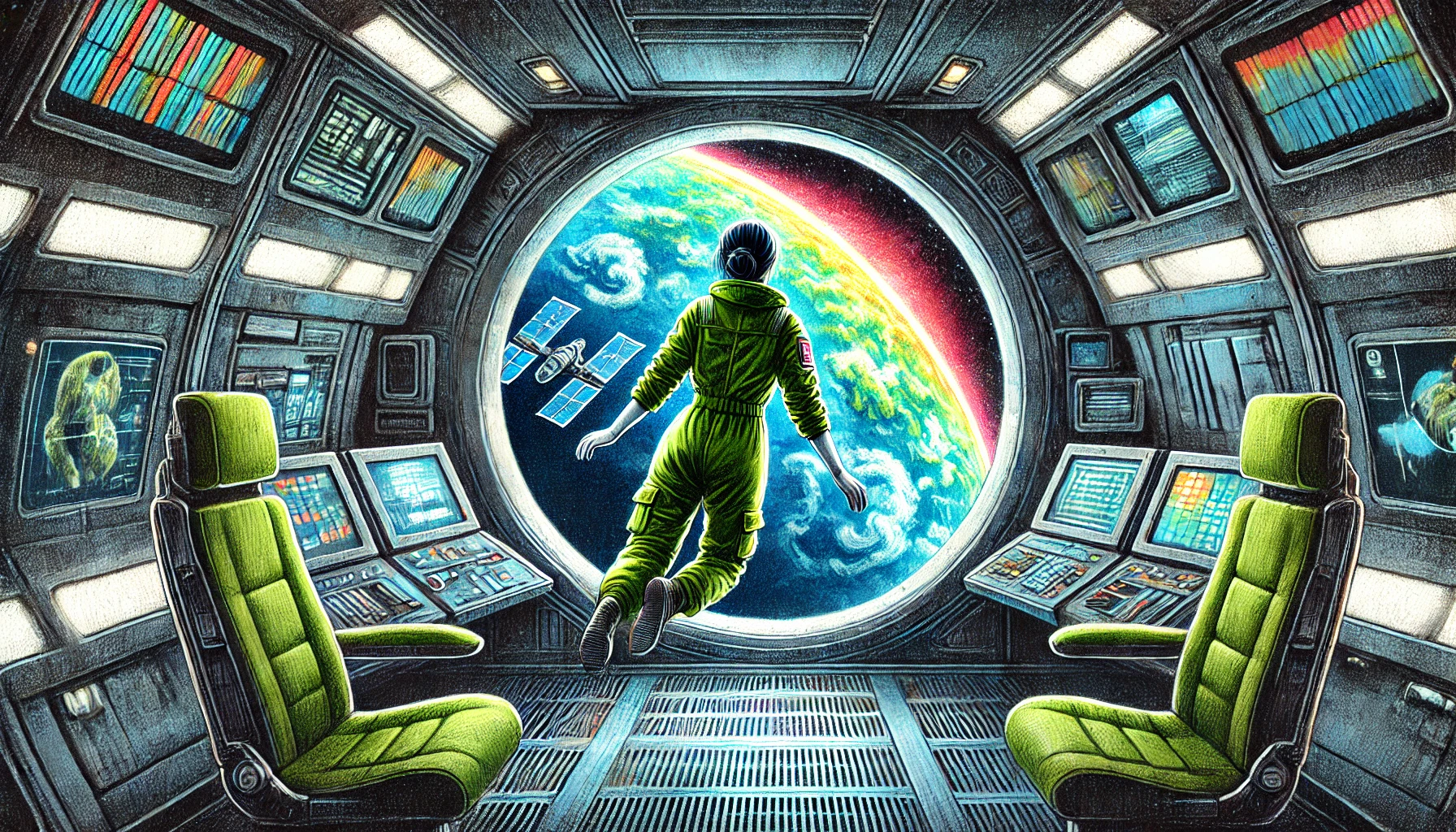
Feeling the weight of the decision on her shoulders, even in zero-g, Valentina undid the straps of her chair and pushed off slightly, allowing herself to gently float away from her chair toward the other end of the command module, the cabin lights rotating in her vision.
“Finn, I need to talk this out. So I’m just going to brain-dump and see if we get anywhere with it. Sound good?”
“Yes, feel free to begin whenever you’re ready.”
Val looked out the small window in the command module, the stars spinning due to their PTC roll. “Okay, let’s say we go to JMTEP’s planet. Worst case scenario, they seize the ship and then kill everyone to avoid having to share resources with fifty people.”
She let out an exasperated breath. Saying it out loud made it feel more real. “And at best, well, frankly, I’m struggling to see any scenario that could actually go well. Even if both parties tried their best to behave themselves, something is going to break down at some point, right, Finn?”
“Your assessment has merit,” Finn said. “This would be an extremely complicated matter that would test everyone’s humanity. On a practical level, the mission goals of NASA versus JMTEP are vastly different. Where NASA seeks to understand, JMTEP has set a historical precedent of exploitation. It is conservation versus manifest destiny. Not exactly conducive to collaboration.”
“One group will always be the loser with any decision,” Val agreed.
She absentmindedly chewed the inside of her cheek, hesitant to talk about the next factor on her mind. “Finn, I assume you’re aware from my personnel file of my family’s history with JMTEP.”
“I am aware that your maternal grandfather, Glen Mortensen, a silicon chip designer for a company contracting with NASA, was killed in a missile strike at the facility he was working at seventy-seven years ago.”
Valentina was confused by the timeline for a moment. In her mind, her grandfather had died thirty-six years ago. But that was before she remembered that traveling at relativistic speeds for forty light-years meant that roughly forty years had passed since she’d left Earth. Now, she was technically older than he was when he died. Time dilation was a son of a bitch.
Her thoughts wandered back to her last memory of her grandfather, his back turned to her as he went out the front door. Her voice cracked when she spoke. “But even setting that aside, what about all the things JMTEP has gotten away with over the years? Factories poisoning groundwater, child slavery in their manufacturing!”
“Board-approved acts of terror,” Finn said, adding to her point.
“I’m sorry, but I just don’t see JMTEP as an option,” Valentina said. “I would rather take our chances by continuing to Firenze. Even if we run out of fuel in orbit around the planet, the fusion core will be able to sustain us long enough to figure something out.”
This is NASA, Val thought. We always figure something out.
“And what of changing course to 1d and joining up with CS4’s colony efforts there?” Finn asked, reminding her of the other option they still had.
Val had floated to the other side of the command module. She pushed off the wall, heading back to her pilot’s seat. Once there, she strapped back in and pulled up the flight plan she’d made to CS4.
“It’s not a horrible option,” Val admitted. “Their approach to colonization aligns with NASA’s. But aren’t they terraforming their planet? That would make living conditions pretty rough, would we even be ready for that?”
“It would certainly be a strain on our resources and push the limits of our life support systems,” Finn agreed.
“And they are kind of cultish,” Val scrunched up her face.
“Comparing them to a cult is an exaggeration,” Finn said. “They are very strict with the rules they follow, but that doesn’t take away from their scientific advancements. Their work on the artificial moon, as a product of their fanaticism, is impressive.”
“Wait, that brings up a good point,” Val said. “How far along will the CS4 colony even be? Weren’t their efforts to create the artificial moon going to put them decades behind everyone else? Will there even be anyone on their planet yet?”
“That is a good point,” Finn acknowledged. “However, Asclepius IV, being a modular ship with a fusion core, could mitigate that somewhat.”
Val wasn’t so sure. Yes, their ship was meant to be taken apart after landing on Firenze and used as infrastructure for the colony. But their ship was meant to be supplemental to the Asclepius ships already on the surface. She wasn’t sure if their ship alone could sustain a growing colony.
Now, suddenly, 1d felt like it wasn’t an option either.
Which meant continuing to Firenze and hoping they could solve whatever problem had arisen on the planet’s surface.
Valentina let out a frustrated sigh, pressing her palms to her temples to relieve the headache she could feel was coming on. “Finn, you mentioned earlier potential ecological or biological problems with our colony. What are the chances we could mitigate one of these issues if we spent the rest of the flight running simulations on these scenarios?”
“If it is ecological, we do have technology on board that could potentially help, technology that the colonists on the surface don’t yet have. If it’s biological, the crew already on the surface would be more capable than our own of handling that sort of issue. That was part of their mission objectives before our arrival.”
“So it might be okay if it’s ecological, but we’re boned if it’s biological.”
“Biological complications would indeed be a worst-case scenario,” Finn finished.
Valentina shook her head. To her, there was only one clear option. “Okay, we are going to continue on course to Firenze.”
“Additionally,” she continued, pulling up the vitals of the hibernating crew on her console screen. “In an effort to preserve as much hydrogen fuel as possible, we will wait to wake the captain until she is scheduled to do so. My thinking is that we’ll want to buy ourselves as much time as possible to prepare before attempting a landing, if we attempt a landing. That means we need time to park in orbit, potentially extending hibernation for the bulk of the crew to preserve resources. That’s my decision.”
“Very well,” Finn said. “Based on our circumstances, I tend to agree.”
Valentina nodded, though she wondered if Finn would have said that no matter what her decision had been. Still, she felt somewhat at ease, even if she wasn’t sure whether that ease was due to relief or a numb resignation.
“However,” Finn began, “I would be remiss in my duties if I didn’t remind you that you still have roughly thirty hours to consider joining forces with JMTEP further.”
“I haven’t forgotten,” Valentina responded.
“Ma’am, I know you asked me to silence all non-essential notifications, but we did receive a unique communication request while you were coming to a conclusion.”
“From the surface?” Valentina asked eagerly. “Did they spell out another message?”
“Strangely enough, the source of the communication attempt originated from a JMTEP base on TRAPPIST-1e,” Finn said.
“JMTEP?” Val asked, her throat suddenly tight with anxiety. “What reason could they possibly have to reach out to us?”
“Would you like me to accept their comms request?” Finn asked.
Valentina couldn’t help but be spooked. The thing she was trying not to think about was thinking about them. How did they know to call at the exact time when she was feeling the most unsure? It felt cruel, and made Valentina wonder if their ship was more visible and vulnerable than she assumed. “There’s no reason they might know more than we do about the situation on our planet, right?”
“It is highly improbable,” Finn said.
Valentina nodded. “Ignore them, if they want to speak with us, they can wait until the captain is awake.”
She couldn’t stomach the idea of speaking with them herself.
Val noticed how much time had passed since they’d begun their discussion. They were only a few minutes away from the window closing for them to change course to CS4’s planet. She absentmindedly gripped the flight joysticks, staring at the delta-V curve that made up the flight plan, an impulsive part of her knowing how easy it would be to just flip a switch and commit them to CS4, rather than having to spend the next thirty hours knowing there were two other options open to her.
But then the moment passed, and just like that, 1d was closed to them. Valentina loosened her grip on the joysticks, letting out a long breath in the process.
It had been a long day, and Valentina was starting to nod off to sleep when Finn alerted her to an updated message from the planet’s surface.
“Finally,” she exclaimed. She shakily scrolled through the new satellite images and could see that they indeed had used large pieces of equipment to spell out a new message.
It was simply four letters: QRTN.
“Q-R-T-N,” Valentina said. “Do you think that’s an acronym for something?”
Finn answered promptly, “No, I believe they are trying to say ‘quarantine.’”
“They want us to quarantine? From what?” Valentina asked.
“I do not believe that is the intended message. They are almost certainly telling us what they are doing, which, in my estimation, is worse. It implies that they are actively trying to contain something. Something they don’t want help with.”
Val pulled up the flight plan to 1d again, wondering if there was any way to still make it to CS4’s planet.
“Course correction now will require reverse thrust, Valentina,” Finn said, anticipating her thought process based on her pulling up the flight plan. “We don’t have the fuel for that.”
Val sighed, wondering if she’d just doomed the crew. If only that message had been received an hour ago. “So the problem is biological then.”
“That is a logical assumption,” Finn replied.
It was the one thing their crew was less equipped to deal with than those already on the surface. And now she was piloting them all toward a quarantine.
All the options that were left to her were to continue flying toward what was most likely death for her and the entire crew, or make a deal with the devil and join JMTEP.
“Well, shit,” she muttered.
“Indeed,” Finn responded.