Chapter One:
Author’s Note: You are reading an early draft of this short story. The story itself is complete, but you may still find grammatical errors or small inconsistencies that would normally be caught in the editing process. Thank you for reading it in this early form.
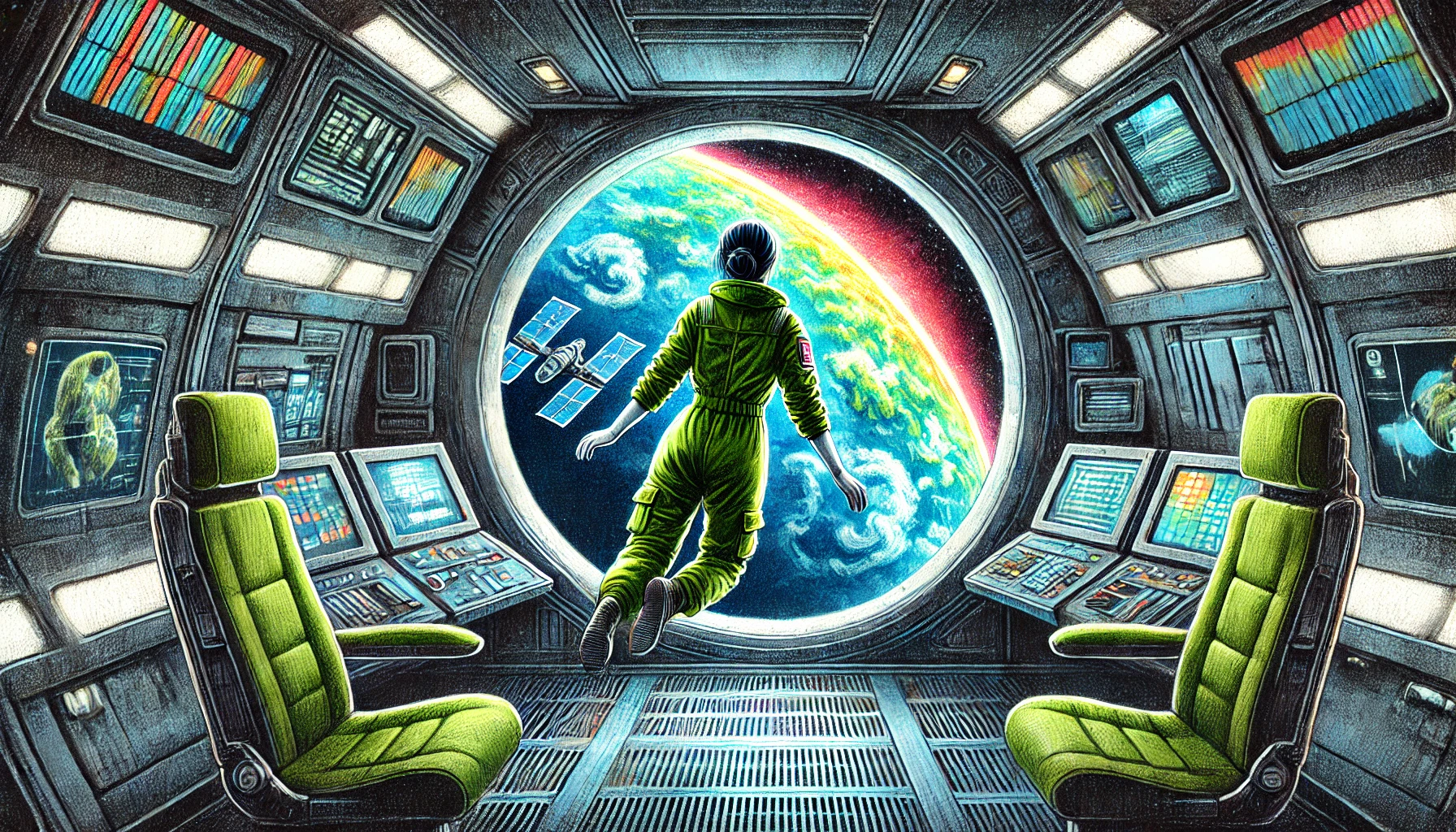
Valentina Nelson had long since gotten used to spending most of her time alone. She’d spent much of her adolescence feeling ashamed of how much alone time she needed—or at least wanted. The times when she hadn’t felt ashamed, she’d been interrogated by school psychologists worried about her lack of friends. But now, at forty years old, floating gently in zero-g and poring over data displayed on the tablet strapped to her forearm, Valentina was in the command module of a NASA colony ship traveling to the exoplanet TRAPPIST-1f, and her talent for solitude was an asset.
Well. In addition to being the pilot of the mission.
The exoplanet’s official designation was TRAPPIST-1f, meaning it was the fifth planet in orbit around the star, with the star itself being TRAPPIST-1a, etc. About a century ago, NASA started calling the planet Firenze, which was the Italian version of Florence, the city in Italy.
There were fifty people onboard the colony ship, forty-nine of whom were still in hibernation, and would remain that way until orbit—except for the captain, who would be woken a day before orbital insertion. But for the past year, Valentina had monitored the ship’s deceleration from near-light-speed travel as they approached the TRAPPIST system. Her main objective was ensuring they stayed on course, which was always a simple matter with NASA. The math done before each burn was so precise she often felt redundant.
Which meant that for the past year, save for the ship’s FORBIN computer to keep her company, Valentina had been completely alone.
Well, calling it a year felt disingenuous to Valentina. Yes, from the time that she was woken from hibernation until they’d finished deceleration, a year had passed on Earth, and on the world they were traveling to. But because of the time dilation, even during deceleration, from her perspective she’d only been awake for fifty days. Still, fifty days was a long time with no human interaction, even for a self-described loner like Valentina.
Val pulled up the module for the FORBIN computer on her wristpad tablet. FORBIN was a super advanced artificial intelligence system, short for Fiber Optic Regulated Binary Input Network.
This wasn’t like the fiber optics of old, simply carrying signals at near light speed. The real breakthrough was FORBIN’s woven lattice. It used electromagnetic fields to process data directly within the fiber structure, bypassing the physical limits of conventional circuitry that had held for centuries. Quantum effects stabilized those fields across the network, allowing computation to occur simultaneously at multiple points. The result was a system that eliminated most transmission delay, with latency measured not in nanoseconds, but attoseconds.
What made it remarkable was its scalability. Plug FORBIN into a single system and it made that system sharper. Plug it into all of them—like say, a complex NASA interstellar ship and it understood the interplay between engines, life support, and navigation guidance better than the people who designed them. It couldn’t replace the systems, but its integration refined them, making them more than the sum of their parts.
To the engineers who developed it, it was the pinnacle of human computational architecture, pressed against the edge of known physics. To everyone else, it was an artificial intelligence that could learn any programming language ever written and operate any system ever made, instantly, just by plugging it in.
To Val, it was a helpful companion. One she’d grown increasingly irritated with over the past fifty days.
“Hey, Finn? When should we be reaching comms range?” Valentina asked. She’d taken to calling the computer Finn, as that was much easier to say when issuing verbal prompts than FORBIN, which didn’t exactly roll off the tongue. And, well, because whether she’d admit it or not, even fifty days completely alone was a bit much for Valentina. Humanizing the ship’s artificial intelligence had been a pretty natural way to lean into having something like a companion.
“In approximately ten minutes, the ship will pass into communication range with Firenze,” FORBIN responded. “We can expect to connect with the colony’s comms within five minutes of …”
FORBIN continued to rattle on about figures and estimates, but Valentina tuned it out. Almost time, she mused. In just a few minutes, she’d be talking with someone from the colony. A real person, having a real conversation with her.
A conversation with Finn didn’t count. Sure, she’d initially resisted humanizing it during her isolation, but it wasn’t like she was one of those people afraid of the FORBIN computer’s sophisticated artificial general intelligence. NASA had developed FORBIN over more than a century, but NASA had always been about utility. That meant its “personality” purposely lacked the depth and nuance of true human communication. Something less sophisticated AIs could simulate remarkably well.
Most people enjoyed speaking with Finn despite that. Back on Earth, when Valentina had first been able to access a FORBIN terminal at the NASA headquarters library, she’d spent hours asking it every question that came to mind: how many flowers, on average, an individual bee would pollinate in a year (estimates vary depending on the source, but FORBIN estimated up to a million); what sort of life might exist on planets based on the chemicals and elements we could detect in their atmosphere (turns out most planets are pretty harsh on the building blocks of life, so we are likely talking about varying kinds of bacteria, not giant bugs or little grey men); and even what postmodern thinkers of the twenty-first century would have thought of humanity’s current space endeavor (“Interstellar colonization is capitalism’s unconscious dream of eternal life. The stars will not liberate man; they will perfect his confinement.”).
But despite how engaging the computer could be, it was still just a simulation of intelligence. A robot that lacked nuance, and lacked passion for the marvels it generated. Marvelous ideas, spoken matter-of-factly. No multiplicity. No friction. She didn’t dislike FORBIN, and she didn’t fear it, but it encapsulated her disappointment with the technology. Despite its advancement—and despite its ability to understand the layers of irony beneath her criticism—there would always be a hollowness to its imitation of the soul.
Of course, she could always be biased. Her father, after all, had been known as something of an eccentric when it came to robotics.
A text notification popped up on Valentina’s display from Finn, letting her know they were now within comms range of the planet. It had taken to using text notifications rather than giving a vocal one when she was lost in thought, like she’d just been. But hearing they were now within range, her chest tightened with excitement—and no small amount of anxiety.
Now in range of the small satellite circling their colony planet, the communications relay for the colonists on the surface, Valentina made a connection request. Given the distance still between their ship and the planet, it could have taken a few minutes to go through, but thankfully it took less than a minute before the satellite confirmed the link.
She tuned into the channel the mission handbook recommended, her hands shaking with anticipation. “Trappist base, this is Lieutenant Nelson of Asclepius IV. Please confirm receipt of contact.”
It was hard not to grin as she waited for a response she knew wouldn’t come for another few minutes. In less than a week, Valentina would be standing on an alien world. It didn’t feel real, but she supposed it would once she was actually there.
Five minutes had already gone by since she’d established contact with the relay satellite. “How much time will we have to communicate with the colony before we lose comms?” Valentina asked, growing impatient.
“The satellite’s orbit will move to the far side of the planet, and we’ll enter a blackout period in approximately fifty minutes,” Finn responded.
Not much time, but still enough to establish contact and exchange status reports before they lost comms. Valentina stared at the small icon in the corner of her monitor, waiting for it to change color and indicate a live feed. Whenever she was anxious like this in normal gravity, her leg would bounce under her. But here in zero-g, even strapped into her seat, that same restless habit was more like her leg vibrating uncomfortably in her forest green jump-suit.
Val wondered if they were having trouble with long-range comms on their end. Presumably, the last time they’d used it was when they communicated with Asclepius III before its arrival three months ago.
On their end, they’d see she’d already attempted contact, so it was pointless to reach out again. Still though…
“Trappist base, Asclepius IV awaiting contact,” Val said into the radio.
While waiting, she checked a few systems, pulling up current fuel levels and making sure the crew’s hibernation cycle hadn’t developed any issues. Now that they’d completed deceleration from relativistic speeds, the ship was maintaining a comfortable cruising speed of 26,000 miles per hour. At this rate, they would reach Firenze in just under six days.
A few moments after checking the extravehicular sensors, Val caught herself staring at one of her monitors, her eyes just out of focus. Her tablet’s haptic feedback squeezed her wrist, indicating fifteen minutes had passed since they’d entered comms range. She forced herself to take a few breaths and focus. Unable to help herself, Valentina pulled up the communications diagnostics. Comms on their ship were working great. In fact, their connection to the satellite in orbit around the planet was strong, and they’d even received a small packet of data in the process.
So why hadn’t they called in yet?
“Finn, can you power-cycle the communications antennas in sequence, making sure to only restart the ones on the side of the ship opposite the planet in our PTC roll?”
“Affirmative,” Finn answered. “But to assuage the anxiety you’re feeling over their lack of contact, understand that the colony has had much to do in preparation for our arrival. There are many reasons that could account for the delay.”
She knew Finn was just reassuring her, but she had a hard time believing not one person was there to answer on a planet that now had one hundred inhabitants.
“Screw this,” Val muttered under her breath. Rather than wait for their connection to go live, she opened the comms channel to the open vox frequency. Sure, it was the equivalent of getting someone’s attention with a megaphone instead of waiting for them to call you. And it was an unsecured line; any of the other colonies on other planets could pick up the transmission if they were listening on the same frequency. But how could anyone expect patience in this situation? “Trappist colony, this is Lieutenant Valentina Nelson of Asclepius IV. Can anyone read me?”
A feeling of dread grew in Val as time continued to slip away. She could no longer focus on anything else. All of her attention was spent waiting.
“Something is wrong,” Valentina breathed as she scanned the command screen, searching the data tables and reports for any indication of what was happening. She even pulled up raw command-line data as it ingested live. “Finn, I need you checking everything relevant. Anything that might explain their lack of contact.”
A notification pinged on the command console, indicating it had now been twenty-five minutes since entering comms range. Finn was right: there were plenty of excuses she could invent for why they hadn’t made contact by this point. But none of them held up against the simple fact that they would have been expecting this. Two manned (and one unmanned) colony ships had already landed on the planet, and even if all one hundred colonists on the surface were busy, the moment Asclepius IV contacted the comms satellite in orbit, they would have received a notification. Which, in Valentina’s opinion, was a complicated way of saying they should have answered by now.
Of course, if everyone on the planet was dead, and they were headed to a graveyard instead of a colony, that would certainly explain the silence. But Val knew those kinds of thoughts weren’t helpful. It was an unwritten rule of space exploration: don’t assume the worst until every other possibility had been eliminated.
She had to do something. There had to be something she could do to try and troubleshoot.
“The satellite has imaging, right? It’s mapping the planet’s surface?” Val asked, an idea starting to form.
Finn indicated yes.
“Can you connect me to that image feed? Specifically of the colony base if that’s possible?” Valentina asked.
It took a few moments for FORBIN to get back to her with the image feed. Unfortunately, it wasn’t live. The satellite was programmed to take an image of the planet’s surface every few minutes, then dump the unprocessed shots into a compressed folder for evaluation later. She opened it and found the database organized by time code. She tried a few entries, frustrated to see there was no further organization beyond when the photo had been taken. Firenze wasn’t huge, but it was still roughly the size of Earth. Finding recent images of the colony base like this would be like finding a needle in a haystack—except the haystack was the size of a planet.
“Finn, scan these and find the most recent images of the base.”
Finn indicated yes, then began downloading the entire repository. The progress bar stayed at 0% long enough for her to know it would take time.
“Look, I know being a highly advanced robot means you aren’t purposefully going slow, but I need you to go faster, alright?”
“Request acknowledged,” Finn answered dryly. “Unfortunately, we are at the mercy of the satellite’s hardware limitations, not our own.”
Taking a deep breath, she leaned her head back and shut her eyes.
Val decided to send another broadcast. “Hey, Asclepius IV here. Y’all busy down there doing surface things? Or just playing hard to get? Well, this gal would appreciate a call back.”
Static was all that answered her.
She pulled up the comms software and requested a hard reboot, figuring it couldn’t hurt. But FORBIN stopped her.
“Ma’am, there is no issue with comms on our end,” Finn said, stopping her.
“Just do it, Finn,” she blurted, surprised at her own outburst. “It would make me feel better if we tried it.”
She gripped the edges of her seat. The straps felt like restraints, making it difficult to breathe normally. But she didn’t want to unbuckle. The idea of floating in zero-g would make her feel even more helpless.
The reboot finished. The green light indicating successful connection to the relay satellite lit up. She swore, wishing there was an issue on her end. She’d rather that be the case than fear the worst about the colonists.
It was hard not to catastrophize. Val tried to think of a rational explanation for why the colony might not have responded yet—anything to explain the silence.
“Someone answer the goddamn line, huh? Can you do that for me?”
“Ma’am,” Finn said gently. “Might I suggest refraining from profanities? NASA is a public organization. These recordings may be archived and reviewed in the future.”
“Finn?”
“Yes, ma’am.”
“Shut the fuck up.”
“Yes, ma’am.”
She sighed, suddenly ashamed of her outburst.
“Sorry,” she muttered, suddenly self-conscious, reminded that her every word and action was being recorded for posterity.
“No apology necessary, ma’am,” Finn responded.
Obviously, she was fearing the worst. It was hard not to. What would they even do if they arrived at a planet full of dead colonists? Hope whatever killed them wouldn’t kill them too? Val shuddered at the thought.
She received a notification that they were now mere moments from entering a signal blackout. The satellite relay would be moving to the other side of the planet. If they were going to make contact, it had to be now.
Val switched back to the channel frequency suggested by the logbook. She knew it didn’t make a difference. The colony should be hearing her either way, but she was desperate. “Colony base, please confirm that you are receiving this transmission. I’m starting to get really worried up here.”
Before ending transmission, she clenched her eyes shut and let out one more word: “Please.”
The haptics in her tablet squeezed her wrist. She opened her eyes long enough to see a notification that the satellite had moved out of range.
They were now in a communications blackout with the colony.
A heaviness settled on Valentina’s chest. An hour ago, she’d been downright giddy at the prospect of talking to someone real.
And now?
Something had to have gone wrong, Valentina thought. Why else wouldn’t they have answered? But that wasn’t even the strangest part. It wasn’t just that they hadn’t answered—the comms never established a connection. And there was no error code, no indication of any issue on their end. They just never connected.
Valentina wasn’t sure how long she’d been sitting there, stewing over what was happening, when Finn sent a notification to the command console to get her attention. She gestured to accept the message and found a series of satellite images of the colony base.
She swiped through them quickly, relieved to see vehicle movement and even heat signatures in the thermal imaging. It meant people were alive down there, at least as of yesterday, according to the time stamps. She scrolled through the rest of the images, scanning each quickly before moving on to the next. She wasn’t sure what she was looking for, other than some obvious indication a disaster had occurred. But the past few weeks of images showed nothing immediately abnormal.
She slumped in her seat, stumped about what to do next. “What are we going to do, Finn?”
“Again, I must reassure you,” Finn said through the command module’s speakers. “We have not yet—” His voice suddenly cut out.
“Finn?” Valentina asked, alarmed. “What is it?”
“I have one other item of note to report,” Finn said. “I missed this in my initial troubleshooting. I scanned for errors in the satellite logs and found none. But moments before blackout, I ran one final pass through the relay satellite’s metadata for anomalies. According to the logs, the colonists disabled their ability to communicate with the relay satellite before even launching it into orbit.”
“Why would they shut it off?” Valentina asked.
“Not shut off,” Finn said. “Removed completely. They would have had to physically remove the transmitter module from the satellite.”
“Sabotage, maybe?” she asked.
“Unclear at this time. We need more data to determine their intentions,” Finn continued. “But according to the satellite’s metadata, the crew on the planet’s surface received our attempts at communication successfully. With the modifications they made to the satellite, it would be impossible for them to respond.”
In all of Val’s panicked, catastrophic thinking, this wasn’t a scenario she would have ever guessed. It didn’t make any sense.
“Should I wake up the captain?” she asked Finn, a hint of dread in her voice.
“We do not have enough data to confirm this is truly an emergency. There are enough potential scenarios that could explain the current situation that, at this point, waking the captain might be premature.”
Valentina nodded. It was what she’d expected. They’d expended most of their fuel getting here, leaving just enough for orbital injection and to keep the hibernation systems running. And with the amount of fuel it took to wake someone early from a hibernation cycle, waking the captain ahead of schedule would be a last resort.
“Any recommendations?” Valentina asked, idly studying the vegetation on the planet’s surface. Finn generated several different courses of action, though she wasn’t really listening—more just staring at the satellite imagery than anything else.
In any other circumstance, she would have been ecstatic to see alien vegetation. This was flora from an exoplanet, so strange, and so different from what they were used to on Earth. Surely it was something to be amazed by, even with the circumstances. But Valentina struggled to muster the enthusiasm.
Wait.
Valentina’s eyes narrowed. She moved the image that caught her eye from the ship’s console to her tablet and zoomed in. At the very edge of the colony base, near a rocky formation surrounded by alien flora, she saw a grouping of vehicles and heavy machinery. Her heart dropped when she saw what they’d spelled out with them—the first definitive message communicated from the surface:
DONT LAND